
The Guardian Middle East
leftREPORTJD Vance claims US holds all the cards in Iran and will win ‘either way’
Full BriefGenerated 59d ago
What Happened
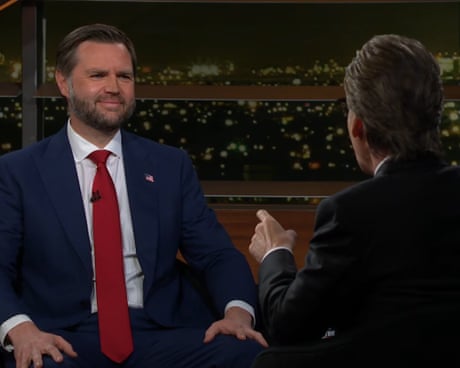
US Vice President JD Vance claimed that the United States 'holds all the cards' in negotiations with Iran and will 'win either way,' asserting that Iran's ability to enrich uranium has been 'destroyed.' He referred to a 60-day memorandum of understanding (MOU) between the Trump administration and Iranian President Masoud Pezeshkian as a temporary framework. Hours before his remarks, a tanker was struck by a projectile in the Strait of Hormuz, and the US and Iran each conducted strikes in what was described as the worst escalation since the interim deal. Washington said it hit Iranian targets overnight, while Iran said it struck targets linked to US forces on Saturday in retaliation; a cargo ship had been attacked on Thursday, triggering the hostilities. IAEA Director General Rafael Grossi stated that reducing Iran's stockpile of 60%-enriched uranium or transferring it abroad remains a viable option while negotiations continue.
Key Actors
- ·JD Vance(U.S. Vice President)Claimed Iran's uranium enrichment ability is destroyed and that the U.S. holds all leverage in negotiations, offering to transform relations if Iran renounces nuclear weapons ambitions.
- ·Masoud Pezeshkian(President of Iran)Engaged in a 60-day MOU with the Trump administration; Iran stated it retaliated with strikes against targets linked to U.S. forces after reported U.S. strikes on Iranian targets.
- ·Rafael Grossi(Director General of the International Atomic Energy Agency (IAEA))Asserted that reducing or transferring Iran's 60%-enriched uranium stockpile remains viable amid ongoing negotiations.
Why It Matters
The juxtaposition of Vance's maximalist rhetoric with a fresh round of military exchanges in the Strait of Hormuz underscores the fragility of the interim US–Iran ceasefire and the high risk of miscalculation. The reported strikes, coupled with the unresolved status of Iran's enriched uranium stockpile, highlight the precariousness of the diplomatic track. Vance's public posture signals a dual approach—offering a 'transformative' reset if Iran capitulates while maintaining that military and economic pressure has effectively neutralized its nuclear breakout capability. The Strait of Hormuz remains a flashpoint for disruption to global oil flows, with oil prices noted at $73 per barrel.
Watch For
Official confirmation and attribution of the tanker and cargo ship attacks; any IAEA board action or technical report on the fate of Iran's 60%-enriched stockpile; expiration or renewal of the 60-day MOU; further naval incidents in the Strait of Hormuz; and the outcome of ongoing negotiations between U.S. and Iranian representatives in Lucerne.
Generated 59d ago · Based on full articleAuto-Compiled
This page aggregates and summarizes reporting from The Guardian Middle East. The Conflict Pulse does not author original reporting. Read the original source for full coverage.
CONFLICT OVERVIEW
Iran
Latest verified updates on Iran’s regional confrontation, U.S.–Israeli strikes, missile retaliation, proxy networks, sanctions, and Strait of Hormuz risks.
SOURCE PERSPECTIVES
How outlets across the bias spectrum are covering this conflict.
LATEST FROM IRAN

REPORTMiddle East Eye11d ago
Iran formalises Strait of Hormuz control as US struggles to sustain war it launched with Israel

REPORTAl Jazeera11d ago
US threatens ‘indefinite’ blockade against Iran: How long can it last?

REPORTMiddle East Eye11d ago
Morning update
REPORTMiddle East Eye11d ago
Vance says US will end up 'in a stronger position' than Iran

REPORTJerusalem Post — Iran News11d ago
US Treasury Secretary Bessent says US to apply measures 'never seen before' on Iran

REPORTAl Jazeera11d ago