BBC Middle East
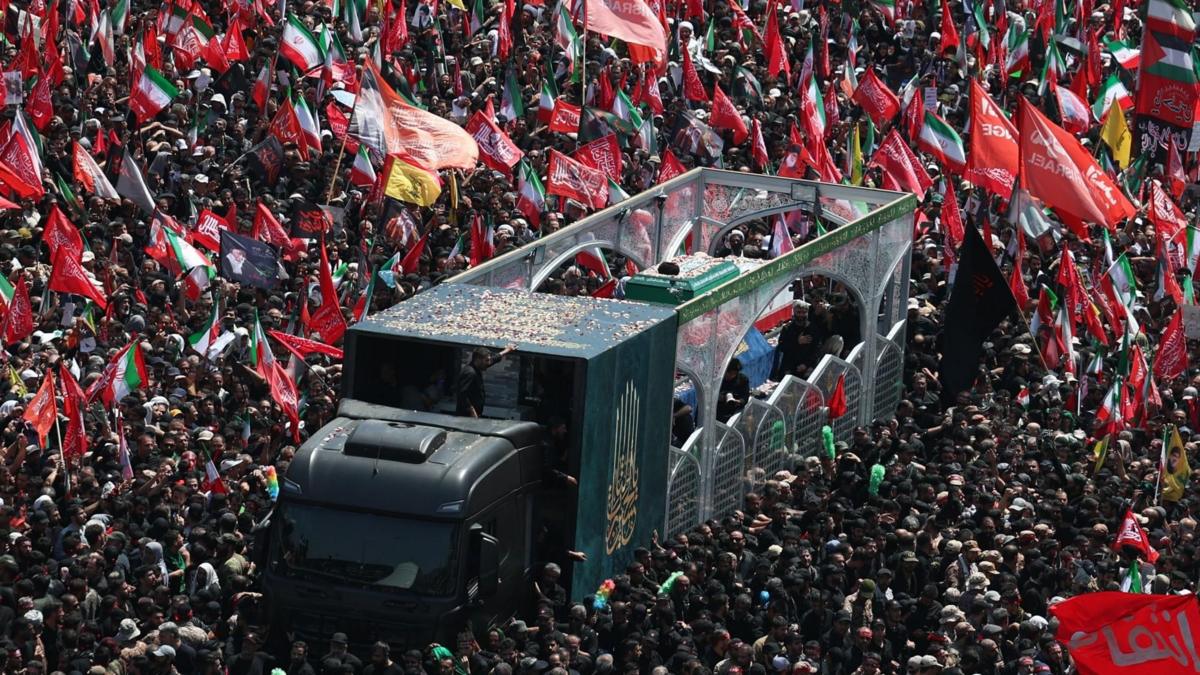
centerREPORTHuge crowds fill Tehran streets for Khamenei's funeral procession
Full BriefGenerated 20d ago
What Happened
Huge crowds filled the streets of Tehran for the funeral procession of Supreme Leader Ayatollah Ali Khamenei, who was killed in an Israeli airstrike on 28 February on the first day of a joint US-Israeli attack that triggered a broader war. The procession, part of three days of public mourning, saw Khamenei's flag-draped coffin transported along a 10km route from Imam Hossein Square to Azadi Square. State media reported millions of mourners waving Iranian flags and red vengeance banners, with some calling for the death of US President Donald Trump and Israeli Prime Minister Benjamin Netanyahu. Former president Mahmoud Ahmadinejad and current president Masoud Pezeshkian attended. Pezeshkian vowed to 'continue the path of Iran's honour.' Israeli Defence Minister Israel Katz declared Khamenei was 'eliminated by Israel' and warned any future Iranian leader pursuing Israel's destruction would be killed. The funeral comes less than three weeks after Iran and the US signed a preliminary agreement to end the war and reopen the Strait of Hormuz, with two months to reach a final deal on Iran's nuclear programme, sanctions, and a permanent truce.
Key Actors
- ·Ayatollah Ali Khamenei(Supreme Leader of Iran (deceased))Killed in an Israeli airstrike on 28 February; his funeral procession drew mass mourning and anti-US/Israel demonstrations.
- ·Masoud Pezeshkian(President of Iran)Attended the funeral and pledged to continue Khamenei's path, emphasising national unity and honour.
- ·Israel Katz(Israeli Defence Minister)Claimed Israel eliminated Khamenei and threatened any future Iranian leader who threatens Israel.
- ·Mahmoud Ahmadinejad(Former President of Iran)Made his first major public appearance since the start of the war at the funeral.
Why It Matters
Khamenei's death and the public funeral occur amid a fragile ceasefire and nuclear negotiations between Iran and the US, brokered by Qatar. The succession of Mojtaba Khamenei, who is reportedly seriously wounded, adds uncertainty to Iran's leadership. The mass demonstrations reflect regime mobilisation and anti-Western sentiment, while Israel's open claim of responsibility signals a more direct confrontation. The two-month deadline for a final deal covering Iran's nuclear programme and sanctions adds urgency to the post-Khamenei transition.
Watch For
Funeral events continue in Qom on Tuesday, the Iraqi shrine cities of Karbala and Najaf on Wednesday, and burial at the Imam Reza shrine in Mashhad on Thursday. Indirect US-Iran talks in Doha are expected to resume after the funeral, with a two-month timeline to finalise the nuclear and sanctions accord. Mojtaba Khamenei's health and public appearance will be a key indicator of the leadership transition's stability.
Generated 20d ago · Based on full articleAuto-Compiled
This page aggregates and summarizes reporting from BBC Middle East. The Conflict Pulse does not author original reporting. Read the original source for full coverage.
CONFLICT OVERVIEW
Iran
Latest verified updates on Iran’s regional confrontation, U.S.–Israeli strikes, missile retaliation, proxy networks, sanctions, and Strait of Hormuz risks.
SOURCE PERSPECTIVES
How outlets across the bias spectrum are covering this conflict.
left
US expands Iran attacks as Trump warns Tehran and Houthis over Red Sea strikes
The Guardian Middle EastHow Chinese tech and Russian tactics are aiding Iran’s bombing of US bases
The Guardian AsiaLATEST FROM IRAN