
The Guardian Middle East
leftREPORTTrump renews Iran blockade and again threatens to take control of strait of Hormuz
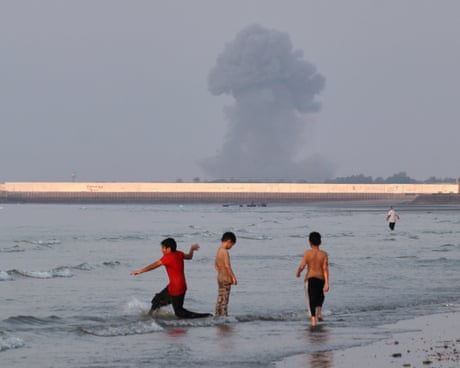
US president declares waterway open and demands tariff as both sides engage in heavy drone and missile exchangesMiddle East crisis live – latest updatesDonald Trump has once again threatened to take control of the strait of Hormuz, as he announced the reimposition of a naval blockade on Iran and demanded a 20% tariff on all cargoes shipped through the key maritime passage. Declaring the strait “open”, Trump suggested in a post on his Truth Social platform that the US should be known henceforth a
Full BriefGenerated 44d ago
What Happened
US Central Command launched a new wave of strikes against Iran at 9pm GMT on Sunday, stating on X that the attacks aimed to degrade Iran's ability to target commercial shipping in the Strait of Hormuz. President Donald Trump confirmed directing the strikes, saying 'We’re beating them up.' Centcom reported around 140 strikes on Saturday night and over 300 Iranian military targets across three nights. In parallel, Iran targeted US facilities across Gulf states on Sunday, including Qatar and the United Arab Emirates, with the UAE saying its air defences engaged missiles and drones. Iranian media reported missile attacks and explosions near the port cities of Sirik and Bandar Abbas, as well as Qeshm Island, while Iran’s Islamic Revolutionary Guard Corps claimed retaliatory strikes on Jordan, Kuwait, Oman, and Qatar—claims not independently verified. Iran’s recently established Persian Gulf Strait Authority declared the strait closed to passage, citing 'illegal US military movements,' and warned vessels against transiting without authorisation. The US Navy-led Joint Maritime Information Centre said an expanded southern route near Oman remained open for two-way traffic. The escalation unravels the interim US-Iranian truce signed last month, with Iran’s foreign ministry stating the strikes 'rendered futile' recent diplomatic efforts and Iran’s top negotiator, Mohammad Bagher Ghalibaf, posting on X that 'the era of one-sided deals is OVER.'
Key Actors
- ·US Central Command (Centcom)(US military combatant command responsible for the Middle East)Conducted multiple waves of strikes against Iranian military targets to protect freedom of navigation, claiming over 300 hits in three nights.
- ·Iranian Foreign Ministry(Iran’s diplomatic arm)Condemned the US strikes as rendering all recent diplomatic efforts futile and blamed Washington for the return of insecurity in the Strait of Hormuz.
- ·Islamic Revolutionary Guard Corps (IRGC)(Iran’s elite military force with regional operations)Claimed retaliatory strikes on Jordan, Kuwait, Oman, and Qatar, though these claims remain unverified.
- ·Mohammad Bagher Ghalibaf(Iran’s top negotiator)Declared the end of one-sided deals on social media, signalling a hardened Iranian negotiating stance.
Why It Matters
The Strait of Hormuz carries roughly one-fifth of the world’s oil and LNG shipments, so any prolonged disruption drives up global energy prices and inflation—oil futures jumped over 3.5% on Monday. The collapse of the interim truce and the failure of Oman-mediated talks raise the risk of a wider regional conflict, drawing in Gulf states both as targets and mediators, and complicate the diplomatic landscape ahead of US congressional elections in November, where fuel prices are politically sensitive.
Watch For
Monitor whether the expanded southern shipping route remains viable, any further US or Iranian strikes, and whether Washington seeks alternative diplomatic channels before the November elections. Watch Iran’s Persian Gulf Strait Authority for any signs of resuming transit permits, and track oil price movements and statements from Gulf capitals—particularly Qatar and the UAE—given their direct targeting and mediation roles.
Generated 44d ago · Based on full articleAuto-Compiled
This page aggregates and summarizes reporting from The Guardian Middle East. The Conflict Pulse does not author original reporting. Read the original source for full coverage.
CONFLICT OVERVIEW
Iran
Latest verified updates on Iran’s regional confrontation, U.S.–Israeli strikes, missile retaliation, proxy networks, sanctions, and Strait of Hormuz risks.
SOURCE PERSPECTIVES
How outlets across the bias spectrum are covering this conflict.
LATEST FROM IRAN

REPORTMiddle East Eye11d ago
Iran formalises Strait of Hormuz control as US struggles to sustain war it launched with Israel

REPORTAl Jazeera12d ago
US threatens ‘indefinite’ blockade against Iran: How long can it last?

REPORTMiddle East Eye12d ago
Morning update
REPORTMiddle East Eye12d ago
Vance says US will end up 'in a stronger position' than Iran

REPORTJerusalem Post — Iran News12d ago
US Treasury Secretary Bessent says US to apply measures 'never seen before' on Iran

REPORTAl Jazeera12d ago