
The Guardian Middle East
leftREPORTUS-Iran talks strained as Trump threats spark Iranian walkout
Full BriefGenerated 64d ago
What Happened
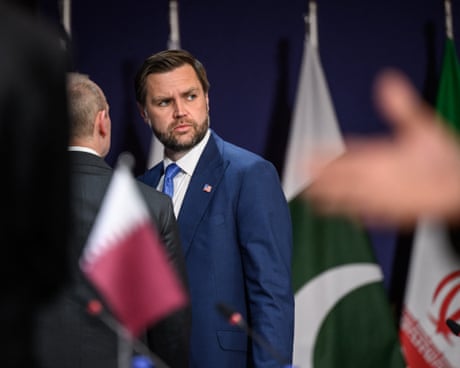
US-Iran talks began in Bürgenstock, Switzerland, with US Vice President JD Vance and Iranian Parliament Speaker Mohammad Bagher Ghalibaf leading delegations. The agenda, originally focused on opening the Strait of Hormuz, lifting US sanctions on Iranian oil exports, and unfreezing Iranian assets, was expanded to include a Lebanon ceasefire after Iran kept the strait closed in protest over President Trump’s inability to force Israel to end fighting with Hezbollah. Iran's delegation included the deputy oil minister and central bank governor, signaling a focus on economic relief. The talks occur amid internal Iranian discord: hardliner Mahmoud Nabavian accused negotiators of exceeding guidelines set by Supreme Leader Mojtaba Khamenei, who had conditionally permitted the talks. President Masoud Pezeshkian defended the memorandum of understanding, claiming its provisions favor Iran and that Trump’s rhetoric had shifted, with the only US demand being a commitment not to develop atomic bombs, which Iran accepted. Meanwhile, a renewed Lebanon ceasefire faltered as Israeli troops and Hezbollah clashed again, and Iran’s central military command announced the Hormuz closure in response to a US “breach of contract.”
Key Actors
- ·JD Vance(US Vice President)Leading the US delegation, pushing for progress on the nuclear issue and Lebanon ceasefire, while linking Hormuz reopening to sanctions relief.
- ·Mohammad Bagher Ghalibaf(Iranian Parliament Speaker)Leading Iran’s delegation, focused on terms for lifting sanctions and unfreezing assets, as indicated by the presence of economic officials.
- ·Mojtaba Khamenei(Supreme Leader of Iran)Opposed the talks but conditionally permitted them, demanding protection of the ‘axis of resistance’ and Iran’s monopoly over the Strait of Hormuz management.
- ·Masoud Pezeshkian(President of Iran)Defending the talks, asserting that the MoU favors Iran, Trump’s stance has altered radically, and Iran signed a pledge not to seek nuclear weapons.
Why It Matters
The negotiations represent a potential inflection point in US-Iran hostilities, with the Strait of Hormuz closure threatening global oil supply and risking economic crisis. Internal Iranian factional strife reveals a tenuous mandate for compromise, as hardliners challenge concessions. The inclusion of Lebanon ties Iran’s core economic demands to a regional ceasefire, making progress contingent on a fragile Israel-Hezbollah truce, while testing the credibility of US guarantees.
Watch For
Monitor whether the Hormuz closure is enforced and whether naval incidents occur; the outcome of the four-way talks and any joint statement; legal actions against Nabavian as a sign of internal crackdown; implementation of the renewed Lebanon ceasefire and its impact on the talks; Trump’s response to domestic pro-Israel pressure and any move to unfreeze Iranian funds or adjust sanctions.
Generated 64d ago · Based on full articleAuto-Compiled
This page aggregates and summarizes reporting from The Guardian Middle East. The Conflict Pulse does not author original reporting. Read the original source for full coverage.
CONFLICT OVERVIEW
Iran
Latest verified updates on Iran’s regional confrontation, U.S.–Israeli strikes, missile retaliation, proxy networks, sanctions, and Strait of Hormuz risks.
SOURCE PERSPECTIVES
How outlets across the bias spectrum are covering this conflict.
LATEST FROM IRAN

REPORTMiddle East Eye10d ago
Iran formalises Strait of Hormuz control as US struggles to sustain war it launched with Israel

REPORTAl Jazeera10d ago
US threatens ‘indefinite’ blockade against Iran: How long can it last?

REPORTMiddle East Eye10d ago
Morning update
REPORTMiddle East Eye10d ago
Vance says US will end up 'in a stronger position' than Iran

REPORTJerusalem Post — Iran News10d ago
US Treasury Secretary Bessent says US to apply measures 'never seen before' on Iran

REPORTAl Jazeera10d ago