
LIVE
Conflict Pulse
· · VERIFIED SOURCES
All RegionsUkraine–RussiaIsrael–PalestineIranVenezuelaUnited StatesSudan / DarfurMyanmarEthiopia / TigrayLebanon
The Guardian Middle East
leftREPORT

Trump threatens further action as US and Iran exchange fire in new flare-up
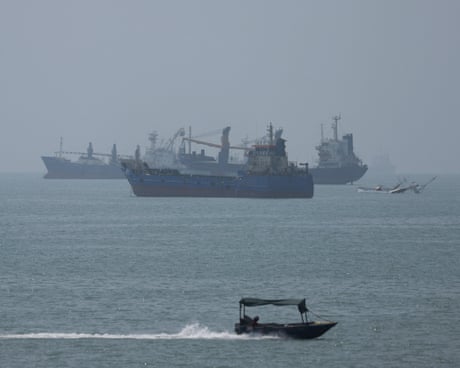
Trump threatens further action as US and Iran exchange fire in new flare-up
NEWS SUMMARY
The US and Iran exchanged fire late Sunday after US forces struck Iranian rocket launchers on Larak Island in the Strait of Hormuz, with Iran responding by targeting US bases in Jordan and the UAE. President Trump threatened further action, while Iran's IRGC claimed three soldiers were killed and warned ships violating its passage rules would face consequences.
Full BriefGenerated 15d ago
What Happened
United States forces conducted strikes against two Iranian rocket launchers on Larak Island in the Strait of Hormuz on Sunday, citing intelligence that the Islamic Revolutionary Guard Corps (IRGC) was preparing to deploy sea mines. In response, the IRGC claimed it launched ballistic missiles at US-operated airbases in Jordan, specifically targeting King Hussein and al-Azraq, while the United Arab Emirates defence ministry reported intercepting a drone over its territorial waters. The IRGC further claimed to have shot down a US MQ-9 drone over the strait. While the US reported no significant impact from the Iranian strikes, the IRGC stated that three soldiers were killed and two citizens wounded during the US attack on Larak Island.
Key Actors
  • ·
    US Central Command(US military combatant command)Conducted strikes on Larak Island to prevent the deployment of sea mines in the Strait of Hormuz.
  • ·
    IRGC(Iranian military branch)Claimed responsibility for retaliatory missile strikes on US bases in Jordan and the downing of a US drone.
  • ·
    Masoud Pezeshkian(President of Iran)Stated that continuing the war is not in Iran's interest and expressed readiness to implement a previously mediated memorandum of understanding with the US.
  • ·
    Donald Trump(President of the United States)Threatened further military action against Iran while maintaining a policy of economic pressure through sanctions.
Why It Matters
The exchange marks a significant escalation in the standoff over the Strait of Hormuz, a critical maritime chokepoint for global energy supplies. The conflict has severely disrupted oil exports, with Tanker Trackers reporting a drop in daily crude transit from 9.8 million barrels during a ceasefire period to 3.8 million barrels currently. The inability of the US and Iran to reach a durable agreement on shipping routes, combined with the US campaign of economic sanctions, has created a volatile environment that risks further kinetic clashes and global inflationary pressure.
Watch For
Monitor the upcoming G20 finance ministers meeting in North Carolina, where the US is expected to pressure allies to impose additional sanctions on Iran. Additionally, watch for potential bilateral discussions between Masoud Pezeshkian and Xi Jinping at the Shanghai Cooperation Organisation summit in Kyrgyzstan regarding Chinese support for the Iranian economy, as well as any further kinetic responses from the US following the President's threats of additional action.
Generated 15d ago · Based on full article
Auto-Compiled
This page aggregates and summarizes reporting from The Guardian Middle East. The Conflict Pulse does not author original reporting. Read the original source for full coverage.
READ ORIGINAL

Iran

Latest verified updates on Iran’s regional confrontation, U.S.–Israeli strikes, missile retaliation, proxy networks, sanctions, and Strait of Hormuz risks.

How outlets across the bias spectrum are covering this conflict.

VIEW ALL IRAN COVERAGE →