
The Guardian Middle East
leftREPORTTrump says Iran peace deal could be signed by Sunday, with strait of Hormuz to open shortly after
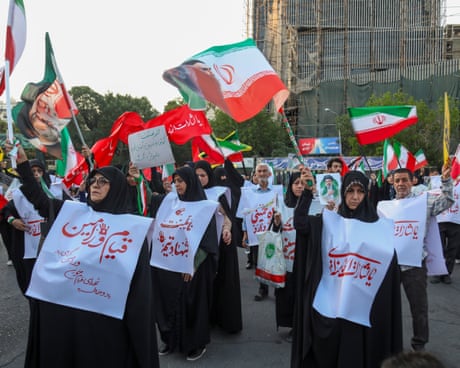
US president says in online post he reserves ‘ultimate alternative’ if Tehran refuses to sign agreementDonald Trump said on Saturday that the US is set to sign a new agreement with Iran the following day, claiming that the deal would prevent Tehran from obtaining a nuclear weapon, as well as reopen the strait of Hormuz to international shipping. In a Truth Social post, Trump said that Iran “no longer want a Nuclear Weapon, nor will they have one, either through purchase, development, or any othe
Full BriefGenerated 74d ago
What Happened
On Saturday, US President Donald Trump announced on Truth Social that the United States would sign a peace agreement with Iran the following day, asserting it would prevent Iran from obtaining a nuclear weapon 'either through purchase, development, or any other form of procurement,' and would immediately reopen the Strait of Hormuz to all shipping. Trump warned of 'the ultimate alternative' if the deal failed. The claim came amid conflicting timelines: Pakistan’s Prime Minister Shehbaz Sharif stated an electronic signing would occur within 24 hours, followed by technical talks next week, while Iranian Foreign Ministry spokesperson Esmaeil Baghaei cautioned that a signing was 'not tomorrow' but possible 'in the coming days.' The reported draft agreement became a point of contradiction: Iran’s semi-official Mehr news agency and Iranian officials described provisions including the release of $24 billion in frozen assets, a 60-day nuclear negotiation period, suspension of oil sanctions, service charges on Strait of Hormuz passage, and lifting of the US naval blockade imposed since April 13. US officials anonymously countered that the deal required destruction of Iran’s nuclear material, dismantlement of its program, and release of frozen funds only upon meeting demands, including ending support for militant groups. Hours after Iranian Foreign Minister Abbas Araghchi claimed 'Iran is the winner,' US forces shot down several Iranian one-way attack drones heading toward the Strait of Hormuz. In Israel, Prime Minister Benjamin Netanyahu expressed concern and continued airstrikes in southern Lebanon, issuing evacuation warnings for Nabatieh and over 20 other locations ahead of raids.
Key Actors
- ·Donald Trump(President of the United States)Announced an imminent peace deal with Iran to be signed Sunday, claiming it would prevent Iranian nuclear acquisition and reopen the Strait of Hormuz, while threatening military action if it fails.
- ·Esmaeil Baghaei(Spokesperson, Iranian Foreign Ministry)Cautioned that the memorandum of understanding would not be signed the next day but did not rule out a signing in the coming days.
- ·Benjamin Netanyahu(Prime Minister of Israel)Clashed with Trump over US demands to curb Israeli military action in Lebanon; Israeli forces conducted airstrikes in southern Lebanon and issued evacuation warnings on Saturday.
Why It Matters
A credible agreement could simultaneously address the intertwined crises of Iran’s nuclear ambitions, the closure of the strategically vital Strait of Hormuz, frozen assets, sanctions relief, and Iran’s support for Axis of Resistance proxies across the region—potentially reshaping the multi-layered standoff that has periodically escalated to direct exchanges between Iran, Israel, and the United States. However, the starkly contradictory public narratives from Washington and Tehran, Trump’s history of claiming imminent deals before reverting to threats, and ongoing Israeli military operations in Lebanon underscore deep uncertainty and the risk of a diplomatic trap or collapse that could trigger wider regional conflict.
Watch For
The claimed signing or collapse of the deal on Sunday; Pakistan’s mediation role and any electronic signing within 24 hours; technical-level talks in the following week; concrete details on the fate of frozen Iranian assets, sanctions on oil and petrochemicals, and service charges for strait passage; verification of Iran’s reported nuclear concessions and any IAEA involvement; US naval and air operations near the Strait of Hormuz following the drone shootdown; and Israel’s military calculus in Lebanon as talks proceed.
Generated 74d ago · Based on full articleAuto-Compiled
This page aggregates and summarizes reporting from The Guardian Middle East. The Conflict Pulse does not author original reporting. Read the original source for full coverage.
CONFLICT OVERVIEW
Iran
Latest verified updates on Iran’s regional confrontation, U.S.–Israeli strikes, missile retaliation, proxy networks, sanctions, and Strait of Hormuz risks.
SOURCE PERSPECTIVES
How outlets across the bias spectrum are covering this conflict.
LATEST FROM IRAN

REPORTMiddle East Eye12d ago
Iran formalises Strait of Hormuz control as US struggles to sustain war it launched with Israel

REPORTAl Jazeera12d ago
US threatens ‘indefinite’ blockade against Iran: How long can it last?

REPORTMiddle East Eye12d ago
Morning update
REPORTMiddle East Eye12d ago
Vance says US will end up 'in a stronger position' than Iran

REPORTJerusalem Post — Iran News12d ago
US Treasury Secretary Bessent says US to apply measures 'never seen before' on Iran

REPORTAl Jazeera12d ago