
The Guardian Middle East
leftREPORTTrump faces fresh bipartisan criticism on Iran deal as Vance hails peace talks
Full BriefGenerated 65d ago
What Happened
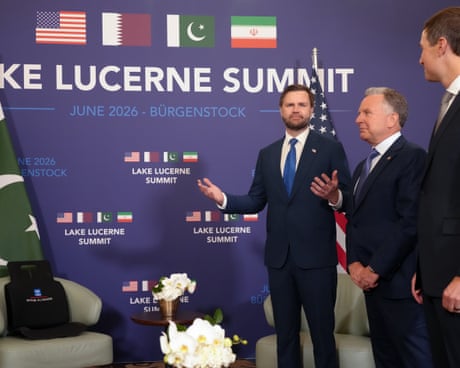
On Sunday, US political figures from both parties criticized President Donald Trump's provisional memorandum of understanding (MOU) with Iran, signed in Paris last Wednesday, while Vice President JD Vance hailed progress after the first round of direct peace talks in Lake Lucerne, Switzerland. Senator John Cornyn (R-Texas) warned that the deal would allow Iran to rebuild its missile assets and resume uranium enrichment, while former national security advisor Susan Rice called the MOU a 'flimsy' and 'egregious' surrender, noting it grants Iran unrestricted oil sales and access to frozen assets before a comprehensive nuclear agreement. Senator Cory Booker (D-New Jersey) described it as 'abject surrender.' Trump threatened to renew military attacks on Iran and potentially take control of the Strait of Hormuz if Iran did not rein in Hezbollah. Vance reported 'great progress' and expressed optimism about the talks' trajectory.
Key Actors
- ·Donald Trump(President of the United States)Signed the MOU with Iran, threatened military action and a possible US takeover of the Strait of Hormuz, and engaged in direct peace talks.
- ·JD Vance(Vice President of the United States)Hailed progress in the Lucerne talks and expressed optimism about resolving the conflict and reducing gas prices.
- ·Susan Rice(Former US national security advisor and UN ambassador under President Obama)Criticized the MOU as a 'horrific surrender' that grants Iran upfront concessions, including unrestricted oil sales, without a full nuclear deal.
Why It Matters
The bipartisan backlash highlights deep domestic divisions over the terms of engagement with Iran, which could undermine the credibility and sustainability of any final agreement. The MOU's concessions, particularly the immediate lifting of oil sale restrictions, may significantly boost Iran's economic leverage and regional influence, while Trump's coercive threats and military posturing risk escalating tensions in the Persian Gulf. The outcome will shape US-Iran relations, the nuclear nonproliferation regime, and the stability of energy markets.
Watch For
Monitor subsequent rounds of US-Iran negotiations in Switzerland for signs of a comprehensive nuclear deal or deadlock. Watch for reactions from Israel, Saudi Arabia, and other Gulf states, as well as any Iranian compliance with demands to restrain Hezbollah. In the US, track Congressional hearings or legislative efforts to challenge the MOU, and observe any changes in US military posture in the Strait of Hormuz. The IAEA inspection cycle and Iranian uranium enrichment levels will be key indicators of nuclear activity.
Generated 65d ago · Based on full articleAuto-Compiled
This page aggregates and summarizes reporting from The Guardian Middle East. The Conflict Pulse does not author original reporting. Read the original source for full coverage.
CONFLICT OVERVIEW
Iran
Latest verified updates on Iran’s regional confrontation, U.S.–Israeli strikes, missile retaliation, proxy networks, sanctions, and Strait of Hormuz risks.
SOURCE PERSPECTIVES
How outlets across the bias spectrum are covering this conflict.
LATEST FROM IRAN

REPORTMiddle East Eye11d ago
Iran formalises Strait of Hormuz control as US struggles to sustain war it launched with Israel

REPORTAl Jazeera11d ago
US threatens ‘indefinite’ blockade against Iran: How long can it last?

REPORTMiddle East Eye12d ago
Morning update
REPORTMiddle East Eye12d ago
Vance says US will end up 'in a stronger position' than Iran

REPORTJerusalem Post — Iran News12d ago
US Treasury Secretary Bessent says US to apply measures 'never seen before' on Iran

REPORTAl Jazeera12d ago