
The Guardian Middle East
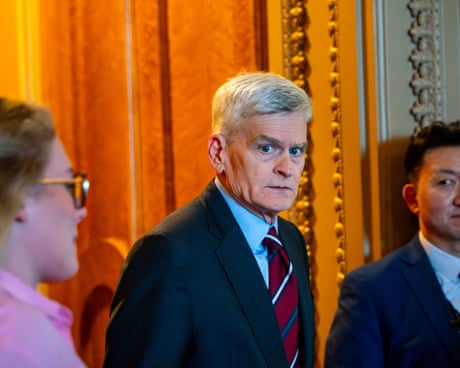
leftREPORTTop Republican decries Trump’s Iran deal: ‘Reagan is rolling over in his grave’
Full BriefGenerated 69d ago
What Happened
The Trump administration released the text of a 14-point memorandum of understanding (MOU) with Iran, describing it as a 'major win' that ends a 110-day conflict and reopens the Strait of Hormuz. The interim deal includes political and financial concessions to Iran, such as a $300bn fund (according to Senator Thom Tillis), and commits Iran to down-blend its enriched uranium stockpile for destruction. Senator Bill Cassidy, a Louisiana Republican who voted to impeach Trump, called the agreement 'the worst foreign policy blunder in decades,' arguing it fails to curb Iran's nuclear ambitions and rewards coercion. Senator Lindsey Graham, after a call with US special envoy Steve Witkoff, endorsed the MOU as beneficial for halting hostilities and reopening the strait, while Vice President JD Vance thanked him publicly. The deal sets a 60-day clock for negotiating a comprehensive final agreement and is due to be formally unveiled at a ceremony in Switzerland.
Key Actors
- ·Trump Administration(Executive branch of the US government, led by President Donald Trump)Negotiated and released the MOU, framing it as a major diplomatic victory that ends the conflict and reopens the Strait of Hormuz.
- ·Bill Cassidy(Republican Senator from Louisiana)Denounced the deal as 'the worst foreign policy blunder in decades,' arguing it fails to curb Iran's nuclear programme and teaches Tehran that threatening the strait yields concessions.
- ·Lindsey Graham(Republican Senator from South Carolina and Trump ally)Initially skeptical, but after a conversation with envoy Witkoff, publicly endorsed the MOU, stating it will stop hostilities and reopen the strait while leaving the door open for a final nuclear deal.
- ·Steve Witkoff(US Special Envoy)Spoke with Senator Graham to address concerns about the MOU, after which Graham expressed support for the agreement.
Why It Matters
The MOU ends a 110-day conflict that caused significant global economic disruption through the closure of the Strait of Hormuz, a critical oil transit chokepoint. The deal exposes deep Republican divisions over Iran policy, recalling past nuclear deal debates, and tests the Trump administration's ability to balance 'maximum pressure' with diplomacy. Critics warn it sets a dangerous precedent by rewarding Iranian coercion, while supporters argue it provides a off-ramp from a costly war and a pathway to a more durable nuclear agreement.
Watch For
The formal unveiling ceremony in Switzerland and the subsequent 60-day negotiation window for a comprehensive final agreement. Monitor IAEA verification of Iran's down-blending and destruction of enriched uranium stockpile, Congressional hearings or votes on the MOU and associated funding (including the $300bn fund), and any Iranian leverage over the Strait of Hormuz reopening as implementation proceeds. Also watch the domestic political fallout, especially after the House war powers resolution vote (215–208 with four Republican defectors) that sought to curb Trump's authority on Iran.
Generated 69d ago · Based on full articleAuto-Compiled
This page aggregates and summarizes reporting from The Guardian Middle East. The Conflict Pulse does not author original reporting. Read the original source for full coverage.
CONFLICT OVERVIEW
Iran
Latest verified updates on Iran’s regional confrontation, U.S.–Israeli strikes, missile retaliation, proxy networks, sanctions, and Strait of Hormuz risks.
SOURCE PERSPECTIVES
How outlets across the bias spectrum are covering this conflict.
LATEST FROM IRAN

REPORTMiddle East Eye11d ago
Iran formalises Strait of Hormuz control as US struggles to sustain war it launched with Israel

REPORTAl Jazeera11d ago
US threatens ‘indefinite’ blockade against Iran: How long can it last?

REPORTMiddle East Eye11d ago
Morning update
REPORTMiddle East Eye12d ago
Vance says US will end up 'in a stronger position' than Iran

REPORTJerusalem Post — Iran News12d ago
US Treasury Secretary Bessent says US to apply measures 'never seen before' on Iran

REPORTAl Jazeera12d ago