
The Guardian Middle East
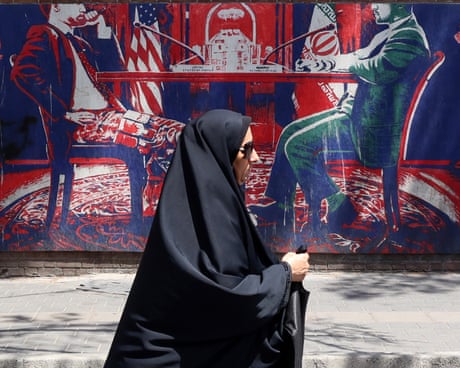
leftREPORTIran agrees to UN nuclear inspectors’ return as part of agreement with US
Full BriefGenerated 1d ago
What Happened
A first day of US-Iran talks in Bürgenstock, Switzerland, mediated by Qatar and Pakistan, concluded with both sides declaring progress. Iranian Foreign Minister Abbas Araghchi said the talks made 'major progress to end Lebanon war,' while a joint mediator statement announced a roadmap toward a final deal within 60 days, including a 'communication line' to avoid incidents in the Strait of Hormuz and a 'de-confliction cell' with Lebanon's government to ensure cessation of military operations. The US Treasury prepared a 60-day waiver lifting sanctions on Iranian oil, petrochemicals, and derivatives, enabling Iran's central bank to sell oil, chiefly to China, without sanctions threat. Qatar and Iran signed a memorandum on releasing frozen Iranian assets from Qatari accounts. The session was briefly disrupted after Trump posted a threatening message on social media, prompting the Iranian delegation to leave the negotiating room and communicate only via mediators, but talks resumed via Pakistani and Qatari mediation. Lower-level technical discussions continue, while principal negotiators—US Vice President JD Vance, Special Envoy Steve Witkoff, and Jared Kushner for the US, and Parliamentary Speaker Mohammad Bagher Ghalibaf and Foreign Minister Araghchi for Iran—concluded their initial exchanges.
Key Actors
- ·Iran(Negotiating party (Islamic Republic of Iran))Declared progress, conditioned further nuclear talks on sanctions relief and Lebanon ceasefire; protested Israeli strikes on Lebanon and threatened Hormuz closure before talks.
- ·United States(Negotiating party (represented by Vice President JD Vance))Sought de-escalation and nuclear agreement, issued sanctions waiver; threatened military action if Iran closes Hormuz or fails to rein in Hezbollah.
- ·Qatar(Mediator)Co-facilitated talks, signed memorandum on Iranian asset release, contributed to roadmap statement.
- ·Pakistan(Mediator)Co-issued joint statement with Qatar outlining 60-day roadmap and de-confliction measures.
Why It Matters
The talks signal a potential de-escalation in US-Iran tensions, directly addressing the linked crises in Lebanon, the nuclear standoff, and Hormuz shipping security. The combination of a sanctions waiver, asset unfreezing, and de-confliction mechanisms could stabilize Iran's economy and reduce prospects for military confrontation. However, unresolved nuclear enrichment issues and Trump's threat posture risk derailing progress.
Watch For
Over the next 60 days: continuation of technical talks this week; actual formation and operation of the Lebanon de-confliction cell and adherence to ceasefire; issuance of the US Treasury oil sanctions waiver and release of Qatari-held assets; Iran's compliance with any additional nuclear transparency or downblending steps; any renewed threats or incidents in the Strait of Hormuz; and further Trump administration statements or actions that could escalate or reverse the diplomatic track.
Generated 1d ago · Based on full articleAuto-Compiled
This page aggregates and summarizes reporting from The Guardian Middle East. The Conflict Pulse does not author original reporting. Read the original source for full coverage.
CONFLICT OVERVIEW
Iran
Latest verified updates on Iran’s regional confrontation, U.S.–Israeli strikes, missile retaliation, proxy networks, sanctions, and Strait of Hormuz risks.
SOURCE PERSPECTIVES
How outlets across the bias spectrum are covering this conflict.
LATEST FROM IRAN

DEVELOPINGAl Jazeera6h ago
Trump disputes Iran’s rejection of nuclear inspectors

DEVELOPINGAl Jazeera6h ago
Rubio begins Gulf visit in the UAE to advance US-Iran peace deal

DEVELOPINGAl Jazeera6h ago
Iran’s president arrives in Pakistan for peace talks

DEVELOPINGAl Jazeera6h ago
US Senate votes to pass Iran war powers resolution in blow to Trump

DEVELOPINGJerusalem Post — Iran News11h ago
IAEA chief, Trump says Iran agreed to nuclear inspections, Tehran denies deal - report
DEVELOPINGBBC Middle East11h ago