
The Guardian Middle East
leftREPORTIran-aligned Houthis claim they attacked oil refinery in Saudi Arabia
Full BriefGenerated 61d ago
What Happened
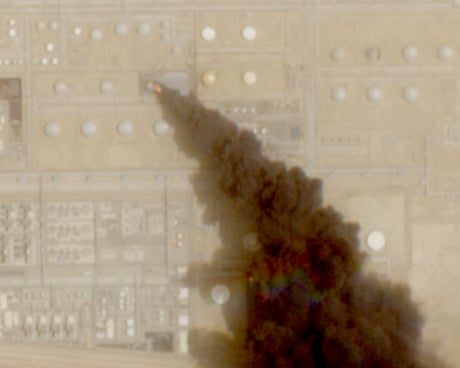
Yemen's Houthi movement claimed responsibility for a drone attack on Saudi Aramco's Jazan refinery early on Sunday, according to Houthi military spokesperson Yahya Saree. The Saudi energy ministry confirmed a fire had broken out at the refinery, which processes 400,000 barrels of crude oil per day, but said it was extinguished without injuries and did not attribute a cause. The claim came two days after Saudi Arabia signed a defence memorandum of understanding with Turkey and Pakistan to strengthen collective deterrence against aggression. The incident occurred against a backdrop of heightened tensions: Iran's Supreme National Security Council secretary, Mohammad Bagher Zolghadr, a former Islamic Revolutionary Guard Corps commander, issued a statement demanding the US end its naval blockade of Iranian ports, withdraw its military, compensate Iran for war damage, lift sanctions, and unconditionally release frozen assets before the Strait of Hormuz would reopen. Iranian Foreign Minister Abbas Araghchi said Iran and Oman were close to a transit route agreement but reopening remained contingent on other conditions. The Houthis also separately claimed missile and drone strikes on the Red Sea port of Mocha, held by the internationally recognised, Saudi-backed government in Aden.
Key Actors
- ·Houthis (Ansar Allah)(Yemeni armed group aligned with Iran)Claimed a drone strike on Saudi Arabia's Jazan refinery and announced a naval blockade against Saudi Arabia in the Red Sea.
- ·Saudi Arabia(Target of the attack and signatory of a new defence pact)Its energy ministry confirmed a fire at the Aramco refinery without attributing cause; the kingdom formed an alliance with Turkey and Pakistan on 5 December 2025 to deter aggression.
- ·Iran(Regional power backing the Houthis and demanding Hormuz reopening)Its Supreme National Security Council secretary set preconditions for reopening the Strait of Hormuz, blaming US violations of a June MoU; Foreign Minister Araghchi spoke of an Oman-mediated transit route.
Why It Matters
The strike on Jazan extends the Houthis' campaign against Saudi energy infrastructure amid a wider Iran-led blockade of Gulf energy shipments, disrupting global supplies. It underscores the multi-front escalation since US and Israeli attacks on Iran began on 28 February, with Iran using its allied armed groups to pressure Gulf states. Saudi Arabia's rapid move to formalise a defence pact with Turkey and Pakistan signals a shift in regional alignment and a search for new security guarantees outside traditional Western frameworks.
Watch For
Whether Saudi Arabia invokes the new defence pact with Turkey and Pakistan in response; any US or Saudi military retaliation; the outcome of Oman-mediated talks on a Hormuz transit route and Iran's stated preconditions; further Houthi attacks on Red Sea shipping or Saudi targets.
Generated 61d ago · Based on full articleAuto-Compiled
DAILY BRIEFING
Follow Iran
Get a daily briefing with the most critical developments from every active conflict zone. Concise. Verified. Free.
No spam. Unsubscribe anytime. Verified sources only.
This page aggregates and summarizes reporting from The Guardian Middle East. The Conflict Pulse does not author original reporting. Read the original source for full coverage.
CONFLICT OVERVIEW
Iran
Latest verified updates on Iran’s regional confrontation, U.S.–Israeli strikes, missile retaliation, proxy networks, sanctions, and Strait of Hormuz risks.
MORE REPORTING ON THIS REGION
Recent reporting from this region. These stories may cover different events.
LATEST FROM IRAN

DEVELOPINGAl Jazeera11h ago
Is Trump signalling a return to war with Iran after the midterms?

DEVELOPINGMiddle East Eye11h ago
Iranian human rights official says legal efforts under way over Minab attack
REPORTThe Guardian Middle East12h ago
Three Saudis killed in Riyadh airport attack claimed by Houthis
REPORTMiddle East Eye14h ago
Morning update

REPORTAl Jazeera15h ago
Trump says US will not strike Iran before midterm elections
REPORTMiddle East Eye15h ago