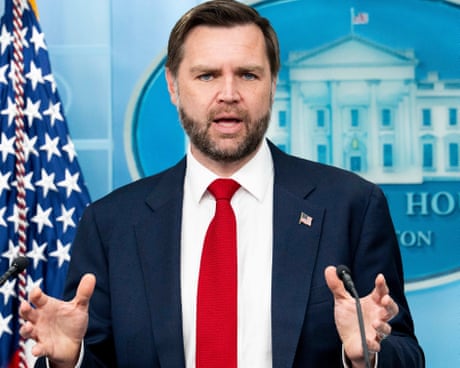
JD Vance’s staff were at an airbase ready to fly to summit in Obbürgen before trip was suddenly cancelledMiddle East crisis – live updatesTalks due to take place on Friday between the US and Iran in Switzerland to implement a peace deal were cancelled as Hezbollah killed four Israeli soldiers and Israel carried out a wave of retaliatory airstrikes in south Lebanon and the Bekaa valley that killed at least 18 people. The talks had been due to begin in the Swiss village of Obbürgen two days afte
Full BriefGenerated 66d ago
What Happened
Talks set for Friday between the US and Iran in Obbürgen, Switzerland, to implement a peace deal were abruptly cancelled on Thursday night, as Israel and Hezbollah traded their most violent strikes since a November 2024 ceasefire. Hezbollah launched salvoes of rocket fire at Israeli forces near Nabatieh, south Lebanon, after intermittent Israeli shelling throughout the day. Israel responded with a wave of airstrikes on Nabatieh and surrounding towns, killing at least 16 people and wounding 33, according to Lebanon’s Ministry of Health. Hezbollah claimed it targeted Israeli forces advancing towards foothills around Nabatieh, a flashpoint where Israeli forces had been advancing prior to the truce. The cancellation came as Vice President JD Vance’s staff and a press pool had already gathered at Joint Base Andrews, and dozens of White House officials were in Switzerland, but a spokesperson said logistics were not predictable and Vance would not depart. Iran’s supreme leader Ayatollah Mojtaba Khamenei had approved the memorandum of understanding signed two days earlier, but Iran’s semi-official Tasnim news agency indicated negotiators needed signs of US implementation before further rounds, and there was no confirmation its delegation would travel. The cancellation followed a report by Al-Mayadeen that Tehran was delaying due to Israel’s military campaign. Israel, not part of the talks and critical of the US-Iran agreement, continued airstrikes and declared a ‘security zone’ in south Lebanon, while accusing Hezbollah of violating the ceasefire; Hezbollah counters that Israel violates it. The MOU calls for permanent termination of the war, Lebanese territorial integrity, and sets a 60-day window for a nuclear agreement, but Israel insists it will not withdraw troops, leading to open criticism from Trump and Vance.
Key Actors
·
Hezbollah(Lebanese Shi'a political-military movement with an armed wing)Hezbollah targeted Israeli forces near Nabatieh with rocket fire, claiming to destroy three Israeli tanks, and accused Israel of violating the ceasefire, while its allied media reported Iran delayed talks due to Israel's campaign.
·
Israel(State actor, represented by the IDF and government)Israel carried out airstrikes in south Lebanon that killed at least 16, declared a 'security zone' in south Lebanon, and insisted it will not withdraw troops, while accusing Hezbollah of ceasefire violations and distancing itself from US-Iran talks.
·
United States(Mediating power, represented by Vice President JD Vance and the White House)The US cancelled the planned talks in Switzerland, with Vance not departing despite preparations; it had lifted a naval blockade of Iranian ports, but Vance publicly criticized Israel for actions that disrupt peace efforts.
·
Iran(State actor, represented by Supreme Leader Ayatollah Mojtaba Khamenei and negotiator Mohammad Ghalibaf)Iran approved the MOU but signalled through Tasnim that implementation steps were needed before further talks, and it did not confirm its delegation would travel; it accused Israel of violating the agreement and warned of a 'decisive response' to breaches.
Why It Matters
The abrupt collapse of the talks, triggered by renewed Israel-Hezbollah violence, threatens to unravel a fragile diplomatic architecture that aimed to end the Lebanon war, stabilize oil routes through the Strait of Hormuz, and frame a permanent nuclear accord. The rupture exposes deep mistrust among parties and risks a broader escalatory cycle just as mediators sought a breakthrough. With over 3,900 killed in Lebanon and 32 Israeli soldiers dead, the conflict continues to destabilize the region, spike energy prices, and test the credibility of US-led mediation. The public rift between Washington and Israel over troop withdrawals adds to uncertainty, while Iran’s conditional stance keeps diplomacy on a knife-edge.
Watch For
Monitor whether technical talks are rescheduled or replaced by other formats, particularly given the 60-day nuclear negotiation clock. Watch for further Israeli airstrikes or Hezbollah rocket attacks that could derail the ceasefire, and for statements from US Vice President Vance or President Trump on Israeli compliance. Track Iranian reactions to Israeli announcements of a 'security zone' and troop presence, and any signs of multilateral pressure or UNIFIL response under UNSCR 1701. Hezbollah’s claims of destroyed tanks and ongoing clashes may signal near-term escalatory intentions if not contained.
Generated 66d ago · Based on full articleAuto-Compiled
This page aggregates and summarizes reporting from The Guardian Middle East. The Conflict Pulse does not author original reporting. Read the original source for full coverage.