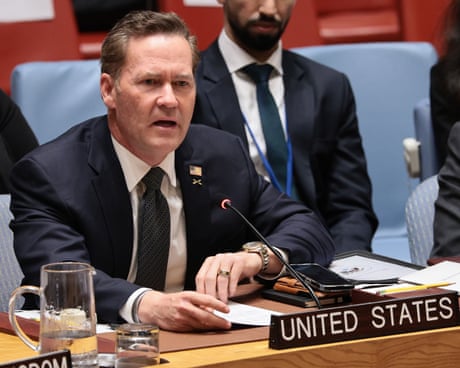
Waltz says Trump rejected Iran’s proposal to end war because they ‘were asking for everything up front’The Trump administration’s ambassador to the United Nations said the US rejected Iran’s proposal to end the ongoing war there because Iranian negotiators “were asking for everything up front”. Echoing comments by Donald Trump on Saturday, the president’s UN ambassador, Mike Waltz, told CNN’s State of the Union on Sunday that Iran had asked for relief “from billions and billions of sanctions tha
Full BriefGenerated 7d ago
The U.S. ambassador to the United Nations, Mike Waltz, said the United States rejected an Iranian proposal to end the ongoing war because Iranian negotiators “were asking for everything up front.” Waltz told CNN’s State of the Union on Sunday that Iran sought relief from “billions and billions of sanctions” under an economic blockade aimed at pressuring Iran to stop attacks on vessels in the Strait of Hormuz, and that Iranian negotiators offered only “a promise that they would then talk.” He claimed Iran “immediately violated” a U.S.-Iran memorandum of understanding signed in Pakistan in June that laid out a 14-point framework agreement by attacking international shipping, and said 146 nations had joined the U.S. in condemning those attacks. President Donald Trump said on Saturday he had rejected Iran’s peace plan proposed at the recent UN General Assembly in New York, arguing Iran was losing and that the U.S. had “total control of the Hormuz strait.” Iran’s Foreign Minister Abbas Araghchi responded on social media that only a negotiated solution can resolve the deadlock and that any move toward reopening the Strait of Hormuz is contingent on Iran’s conditions being met. In an NBC interview, Araghchi said Iran is “fully prepared for the war to be resumed” but remains ready for diplomacy. Iranian President Masoud Pezeshkian told CBS that Iran is ready for talks on its nuclear program and other issues but will not accept “bullying or coercion,” and that Iran had already agreed it is “not supposed to develop nuclear weapons.” Waltz also said Trump had raised reports of Chinese assistance to Iran in missile targeting of shipping and U.S. military bases with Chinese President Xi Jinping, did not confirm leaked intelligence assessments, and cited readouts saying the U.S. and China had agreed Iran can never have a nuclear weapon. Waltz rejected a Wall Street Journal report that the U.S. would resume bombing Iran after the federal midterm elections in November.
- ·
Mike Waltz(U.S. ambassador to the United Nations)Said the U.S. rejected Iran’s proposal, accused Iran of negotiating in bad faith and violating the June MOU, and addressed reported Chinese assistance to Iran.
- ·
Donald Trump(U.S. president)Said he rejected Iran’s peace plan, claimed the U.S. was winning and had total control of the Strait of Hormuz, and raised Iran concerns with Xi Jinping.
- ·
Abbas Araghchi(Iranian foreign minister)Said only a negotiated solution can end the deadlock, set conditions for reopening the Strait of Hormuz, and said Iran is prepared for war but still ready for diplomacy.
- ·
Masoud Pezeshkian(Iranian president)Said Iran is ready for nuclear talks but will not accept bullying or coercion, and stated Iran is not seeking war but will defend itself.
The exchange marks a public collapse of the latest U.S.-Iran diplomatic track amid an economic blockade and a standoff over the Strait of Hormuz, a critical global oil transit chokepoint. Waltz’s framing of Iran as not negotiating in good faith, combined with Iranian officials’ insistence on conditions and readiness for renewed war, signals a high risk of renewed direct confrontation. The reported U.S.-China high-level agreement that Iran can never have a nuclear weapon, and Waltz’s denial of a planned post-midterm bombing campaign, also bear on whether Washington pursues military escalation or further sanctions.
Monitor whether either side makes a new diplomatic proposal or whether Iranian statements about reopening the Strait of Hormuz are followed by actions against shipping. Watch for any U.S. military moves before or after the federal midterm elections in November, which the Wall Street Journal reported could include resumed bombing of Iran, a claim Waltz rejected. Also track further U.S.-China readouts or statements on Iran’s nuclear program and any formal IAEA or UN Security Council activity tied to the dispute.
Generated 7d ago · Based on full articleAuto-Compiled