
naharnet.com
centerREPORTLebanon , Israel , US sign trilateral framework agreement in Washington
Full BriefGenerated 59d ago
What Happened
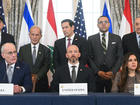
On Friday, Lebanon, Israel, and the United States signed a trilateral framework agreement in Washington aimed at advancing a peace deal. U.S. Secretary of State Marco Rubio, Lebanese Ambassador Nada Hamadeh Moawad, and Israeli Envoy Yechiel Leiter attended the signing. The agreement reportedly includes a pilot effort to have the Lebanese Armed Forces take control of two areas currently occupied by Israel — one south of the Litani River and one north — and establishes a U.S.-facilitated military working group to oversee the disarmament of Hezbollah. Rubio announced $100 million in humanitarian assistance and $30 million in reimbursement to Lebanon's army. However, Israeli Prime Minister Netanyahu stated that Israel would not withdraw until Hezbollah relinquishes its weapons, while Hezbollah Secretary-General Naim Qassem demanded a complete and unconditional Israeli withdrawal. The article notes that the framework follows five rounds of talks and a fragile ceasefire announced this month, but previous truce efforts in April failed to stop fighting. The text of the agreement was not released.
Key Actors
- ·United States(Mediator and signatory)Secretary of State Marco Rubio endorsed the framework as the beginning of a peace process, pledging $100 million in humanitarian aid and $30 million to strengthen Lebanon's army, and facilitating a military working group.
- ·Israel(Occupying power and signatory)Prime Minister Netanyahu conditioned any withdrawal on Hezbollah's disarmament; envoy Leiter declared the deal sidelines Iran and Hezbollah.
- ·Lebanon (government)(Sovereign state participant)Ambassador Moawad described the accord as a first step toward restoring sovereignty and territorial integrity, and the Lebanese embassy confirmed the pilot areas and disarmament clause.
- ·Hezbollah(Non-state armed group)Secretary-General Qassem rejected the framework unless it ensures Israel's unconditional withdrawal from all Lebanese territory.
Why It Matters
The agreement represents a tentative but concrete diplomatic step toward resolving the Israel-Hezbollah conflict, which has displaced over a million and caused thousands of casualties. It signals U.S. reengagement and attempts to bolster the Lebanese state’s military capacity while simultaneously seeking to disarm Hezbollah, a core Israeli and U.S. demand. The contradictory positions of Israel and Hezbollah on withdrawal and disarmament underscore the fragility of the process. The pilot areas south and north of the Litani challenge the status quo of Israeli occupation and Hezbollah’s armed presence, testing the viability of UNSCR 1701 implementation and the broader regional power balance involving Iran.
Watch For
Implementation of the two pilot areas, including timelines for Lebanese Army deployment and Israeli force movements; the initial meetings and mandate of the U.S.-facilitated military working group; reactions from Hezbollah and potential spoiler attacks; parliamentary or cabinet-level approval processes in Lebanon and Israel; and any concrete disarmament steps or resistance. Also, the next round of negotiations and whether the fragile ceasefire holds beyond this month, as the framework’s details are still contested.
Generated 59d ago · Based on full articleAuto-Compiled
This page aggregates and summarizes reporting from naharnet.com. The Conflict Pulse does not author original reporting. Read the original source for full coverage.
CONFLICT OVERVIEW
Lebanon
Latest verified updates on Lebanon, Hezbollah, Israel–Lebanon escalation, southern border fighting, displacement, state authority, and ceasefire diplomacy.
Active since October 2023
SOURCE PERSPECTIVES
How outlets across the bias spectrum are covering this conflict.
Limited perspective coverage. Only center-leaning sources currently tracked for this region.
LATEST FROM LEBANON

REPORTMiddle East Eye11d ago
Hezbollah accuses Lebanon’s government of targeting ‘resistance’ instead of Israel: Report

REPORTMiddle East Eye11d ago
‘They’re all catastrophic’: The paediatric war wounds Dr Abu Sittah tries to heal in Lebanon
REPORTMiddle East Eye11d ago
Israeli forces will not withdraw from south Lebanon or Gaza, Katz says
REPORTMiddle East Eye12d ago
Human Rights Watch says UN must keep peacekeepers in Lebanon

REPORTAl Jazeera12d ago
Lebanese Americans sue US over Israel’s rights abuses in Lebanon war

REPORTMiddle East Eye12d ago