
The Guardian Middle East
leftREPORTIran’s president denies threatening to resign during talks over strait of Hormuz
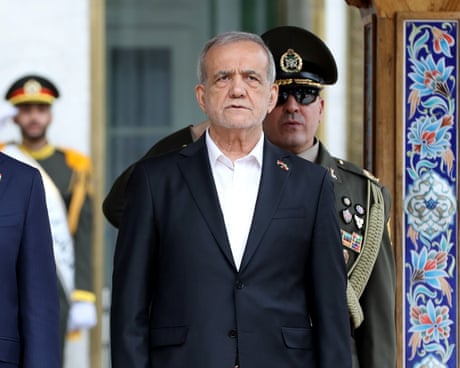
Masoud Pezeshkian dismisses talk of internal rift as hardline Assembly of Experts call US negotiations ‘futile’Middle East crisis live – latest updatesMasoud Pezeshkian, Iran’s president, has been forced to deny claims that he has repeatedly threatened to resign as he battles hardline factions opposed to reaching a settlement with the US over the strait of Hormuz. The US and Europe hope a deal is imminent to reopen the strait and they are putting pressure on Oman to accept a temporary agreement
Full BriefGenerated 19d ago
What Happened
Iran’s President Masoud Pezeshkian denied claims that he repeatedly threatened to resign due to frustration over being excluded from decision-making by hardliners, including Supreme Leader Mojtaba Khamenei. The allegations were made by Mohammad Bagher Kharazi, who is linked by marriage to Khamenei, and reported that Khamenei had warned he would accept the next resignation threat. Khamenei's office dismissed the claims as “fundamentally false and untrue.” Pezeshkian, in a television interview marking his second anniversary in office, asserted he was in harmony with the military and would not resign, while defending a US-negotiated memorandum of understanding on the Strait of Hormuz that has drawn fierce opposition from hardline factions, including the Assembly of Experts, which labelled hopes for an agreement “futile” and a “mirage.”
Key Actors
- ·Masoud Pezeshkian(President of Iran)Denied resignation threats, asserted harmony with the military, and defended negotiations with the US over the Strait of Hormuz.
- ·Mohammad Bagher Kharazi(Brother-in-law of Mojtaba Khamenei's brother)Claimed Pezeshkian had repeatedly threatened to resign and accused the supreme leader of excluding the president from decision-making.
- ·Office of Supreme Leader Mojtaba Khamenei(Supreme Leader of Iran)Issued a statement calling the resignation claims fundamentally false and untrue.
- ·Assembly of Experts(Iranian clerical body)Condemned engagement with the US as futile and described any agreement as a mirage.
Why It Matters
The row exposes a deep rift between reformist President Pezeshkian and hardline factions, including the newly elevated Supreme Leader Khamenei, over whether to pursue a settlement with the US on the Strait of Hormuz. The outcome will shape Iran’s foreign policy direction, the viability of any deal to reopen the strategic oil shipping channel, and the internal balance of power at a time when Khamenei has remained unseen since an Israeli strike. A collapse of the talks or a presidential resignation could trigger a domestic political crisis and heighten regional tensions.
Watch For
Watch for concrete steps on the Oman-mediated memorandum of understanding between Iran and the US, including any public announcements of terms or timelines. Monitor statements from Pezeshkian, Khamenei’s office, and the Assembly of Experts for further signs of discord or policy shifts. Pay attention to any public appearance or communication from Supreme Leader Khamenei, as his prolonged absence fuels speculation about power dynamics. Also note any incidents in the Strait of Hormuz or related diplomatic moves by Western and Gulf states.
Generated 19d ago · Based on full articleAuto-Compiled
This page aggregates and summarizes reporting from The Guardian Middle East. The Conflict Pulse does not author original reporting. Read the original source for full coverage.
CONFLICT OVERVIEW
Iran
Latest verified updates on Iran’s regional confrontation, U.S.–Israeli strikes, missile retaliation, proxy networks, sanctions, and Strait of Hormuz risks.
SOURCE PERSPECTIVES
How outlets across the bias spectrum are covering this conflict.
LATEST FROM IRAN

REPORTMiddle East Eye9d ago
Iran formalises Strait of Hormuz control as US struggles to sustain war it launched with Israel

REPORTAl Jazeera9d ago
US threatens ‘indefinite’ blockade against Iran: How long can it last?

REPORTMiddle East Eye9d ago
Morning update
REPORTMiddle East Eye9d ago
Vance says US will end up 'in a stronger position' than Iran

REPORTJerusalem Post — Iran News10d ago
US Treasury Secretary Bessent says US to apply measures 'never seen before' on Iran

REPORTAl Jazeera10d ago