
naharnet.com
centerREPORTDisplaced families bury relatives in temporary graves
Full BriefGenerated 115d ago
What Happened
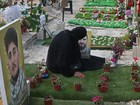
At a temporary burial site in Haret Saida cemetery near Sidon, southern Lebanon, displaced families are burying their dead because they cannot return to their border villages due to ongoing Israeli attacks, despite a ceasefire announced in April. Ghada Hussein’s son, Mohammad Tufayli, a Hezbollah fighter and engineer in his early thirties, was killed last month in an Israeli strike; his body lies in one of dozens of makeshift graves lined with cement blocks and construction-board coffins. Hassan Saleh, responsible for burials, said 120 people have been temporarily interred since hostilities resumed on March 2, including combatants and civilians, with new graves still being dug. Bodies are sometimes buried together when whole families are killed. Lebanese authorities report over 3,700 killed since March 2 and more than one million displaced. A separate burial of Hezbollah fighter Hassan Ali Kallas took place during the report, his relatives prevented from reaching Nabatieh al-Fawqa by heavy Israeli bombardment.
Key Actors
- ·Ghada Hussein(Displaced mother from Kfar Tibnit, near the Israeli border)Grieving the loss of her son Mohammad Tufayli, a Hezbollah fighter, and vowing to eventually rebury him in his destroyed village.
- ·Hassan Saleh(Official responsible for burials at Haret Saida cemetery)Overseeing the rapid expansion of temporary graves, stating that 120 people have been buried since March amid ongoing Israeli operations.
- ·Lebanese authorities(State institutions reporting casualties and displacement)Accusing Israel of killing over 3,700 people and displacing more than one million, while providing burial logistics for the displaced.
- ·Israel (IDF)(Military force conducting operations in southern Lebanon)Accused by Lebanese officials of sustained aerial and ground attacks that prevent villagers from returning, though no direct IDF statement is included.
Why It Matters
The temporary graves illustrate the humanitarian and social toll of a conflict that has re-intensified despite a ceasefire, trapping over a million displaced Lebanese and rendering border villages uninhabitable. With thousands dead and burial rites disrupted, collective grief in Shia communities — where Hezbollah draws support — is deepened, potentially hardening resolve and complicating diplomatic efforts. The Lebanese state's inability to secure returns underscores the fragility of the April ceasefire and the contested implementation of UNSCR 1701.
Watch For
Indicators of whether the April ceasefire can be revived or collapses entirely; signs of international diplomatic pressure or UNIFIL-facilitated returns to the border area; escalations in Israeli strikes or Hezbollah counterattacks that further delay civilian return; and the humanitarian impact as mass displacement persists.
Generated 115d ago · Based on full articleAuto-Compiled
DAILY BRIEFING
Follow Lebanon
Get a daily briefing with the most critical developments from every active conflict zone. Concise. Verified. Free.
No spam. Unsubscribe anytime. Verified sources only.
This page aggregates and summarizes reporting from naharnet.com. The Conflict Pulse does not author original reporting. Read the original source for full coverage.
CONFLICT OVERVIEW
Lebanon
Latest verified updates on Lebanon, Hezbollah, Israel–Lebanon escalation, southern border fighting, displacement, state authority, and ceasefire diplomacy.
Active since October 2023
MORE REPORTING ON THIS REGION
Recent reporting from this region. These stories may cover different events.
This selection currently contains center-leaning sources.
LATEST FROM LEBANON

REPORTMiddle East Eye3d ago
South Lebanon: 'It's torture, they are razing our lives before our eyes'

REPORTAl Jazeera3d ago
Syria denies officials held ‘secret’ talks with Hezbollah in Turkiye

REPORTMiddle East Eye3d ago
Syria denies that it met Hezbollah in Turkey

REPORTMiddle East Eye5d ago
‘We are stuck here’: In cramped shelters, Lebanon’s displaced dream of their villages

REPORTMiddle East Eye6d ago
US Treasury secretary calls on Lebanon to take 'decisive action' against Iranian financial networks
REPORTMiddle East Eye6d ago