
naharnet.com
centerREPORTAoun and US general discuss preparations for implementing deal with Israel
Full BriefGenerated 97d ago
What Happened
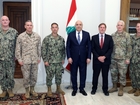
President Joseph Aoun met with U.S. Central Command chief Admiral Brad Cooper, U.S. Chargé d'Affaires Keith Hannigan, and Chief of Staff of the 2024 ceasefire mechanism team General Joseph Clearfield at Baabda Palace on Monday to discuss preparations for implementing a trilateral framework agreement signed on Friday between Lebanon, Israel, and the United States. The agreement seeks to end hostilities after Hezbollah rocket fire in March triggered Israeli airstrikes and a ground invasion, committing Lebanon to restoring sovereignty through 'verified disarmament of non-state armed groups and dismantlement of associated infrastructure' and enabling a progressive Israeli withdrawal. Aoun emphasized the Lebanese state's determination to extend its authority to the southern international border via its armed forces, and U.S. Secretary of State Marco Rubio announced $30 million in reimbursement for the Lebanese army to improve its capability and capacity.
Key Actors
- ·Joseph Aoun(President of Lebanon)Hosted the meeting to discuss implementation of the framework agreement and stressed extending state authority to the southern border through the Lebanese Armed Forces.
- ·Admiral Brad Cooper(Chief of U.S. Central Command)Led the U.S. delegation in talks on launching the framework's implementation and strengthening cooperation, following talks in Israel.
- ·Sheikh Naim Qassem(Hezbollah Secretary-General)Declared the framework agreement 'null and void' and called instead for implementation of a U.S.-Iran memorandum of understanding to halt the regional war.
- ·General Rodolphe Haykal(Lebanese Army Commander)Met with Cooper to discuss the importance of successfully implementing the security annex of the framework agreement and ways to strengthen future cooperation.
Why It Matters
The high-level meeting underscores a U.S.-backed push to separate Lebanon from the broader Iran-linked conflict by empowering the Lebanese Armed Forces and securing verified Hezbollah disarmament, a core demand of the framework. Hezbollah's outright rejection of the agreement, coupled with its reservation of self-defense after Israeli attacks, signals deep contestation over the ceasefire's implementation. This standoff risks stalling the process or reigniting hostilities, while the U.S. financial commitment tests the Lebanese military's willingness and capacity to assert control over Hezbollah's infrastructure south of the Litani.
Watch For
Concrete steps by the Lebanese Armed Forces to begin verified disarmament operations under the security annex, as this will indicate the state's practical commitment to the framework over Hezbollah's objections. Monitor Hezbollah's military response to any Israeli violations of the ceasefire, which could derail the agreement. Additionally, watch for the deployment of the $30 million U.S. reimbursement to the Lebanese army and whether it translates into enhanced operational capacity along the southern border.
Generated 97d ago · Based on full articleAuto-Compiled
DAILY BRIEFING
Follow Lebanon
Get a daily briefing with the most critical developments from every active conflict zone. Concise. Verified. Free.
No spam. Unsubscribe anytime. Verified sources only.
This page aggregates and summarizes reporting from naharnet.com. The Conflict Pulse does not author original reporting. Read the original source for full coverage.
CONFLICT OVERVIEW
Lebanon
Latest verified updates on Lebanon, Hezbollah, Israel–Lebanon escalation, southern border fighting, displacement, state authority, and ceasefire diplomacy.
Active since October 2023
MORE REPORTING ON THIS REGION
Recent reporting from this region. These stories may cover different events.
This selection currently contains center-leaning sources.
LATEST FROM LEBANON

REPORTMiddle East Eye3d ago
South Lebanon: 'It's torture, they are razing our lives before our eyes'

REPORTAl Jazeera3d ago
Syria denies officials held ‘secret’ talks with Hezbollah in Turkiye

REPORTMiddle East Eye3d ago
Syria denies that it met Hezbollah in Turkey

REPORTMiddle East Eye4d ago
‘We are stuck here’: In cramped shelters, Lebanon’s displaced dream of their villages

REPORTMiddle East Eye6d ago
US Treasury secretary calls on Lebanon to take 'decisive action' against Iranian financial networks
REPORTMiddle East Eye6d ago